Lightweight Aerospace Frames: Structural Trade-offs
When minimizing mass and maximizing stiffness pull in opposite directions, exploring a wider design space is the only way to find where they converge.

Notes on structural topology, physics constraints, generative methods, and engineering choices behind P1.
When minimizing mass and maximizing stiffness pull in opposite directions, exploring a wider design space is the only way to find where they converge.

Adding real physics validation as a hard gate, not a soft filter, changes which design candidates survive and which get eliminated early.
Engineering teams trained to refine one promising concept are not wrong, they are resource-constrained. A different mode of working becomes possible when the exploration itself is automated.
A 2mm shift in nozzle exit angle influences combustion stability, thermal load distribution, and thrust vector margin in ways that take hours to trace by hand.
Physics simulation requires expertise, compute time, and an engineer willing to rerun the same model with incremental tweaks. That loop is slow by design, and teams work around it by narrowing what they even attempt to explore.
Heat dissipation in small satellites and compact propulsion systems cannot rely on convection. Conduction paths through structure become the primary thermal management tool, and topology matters enormously.
Lookup tables and analytical solutions exist for standard cross-sections. Generative design produces non-standard shapes. Automated FEA that runs without an analyst in the loop is a prerequisite for any practical generative design system.
Not automation of judgment. Not a black box that produces a CAD file. Something closer to a tireless colleague who can run the physics checks and report back on which options are even worth discussing.
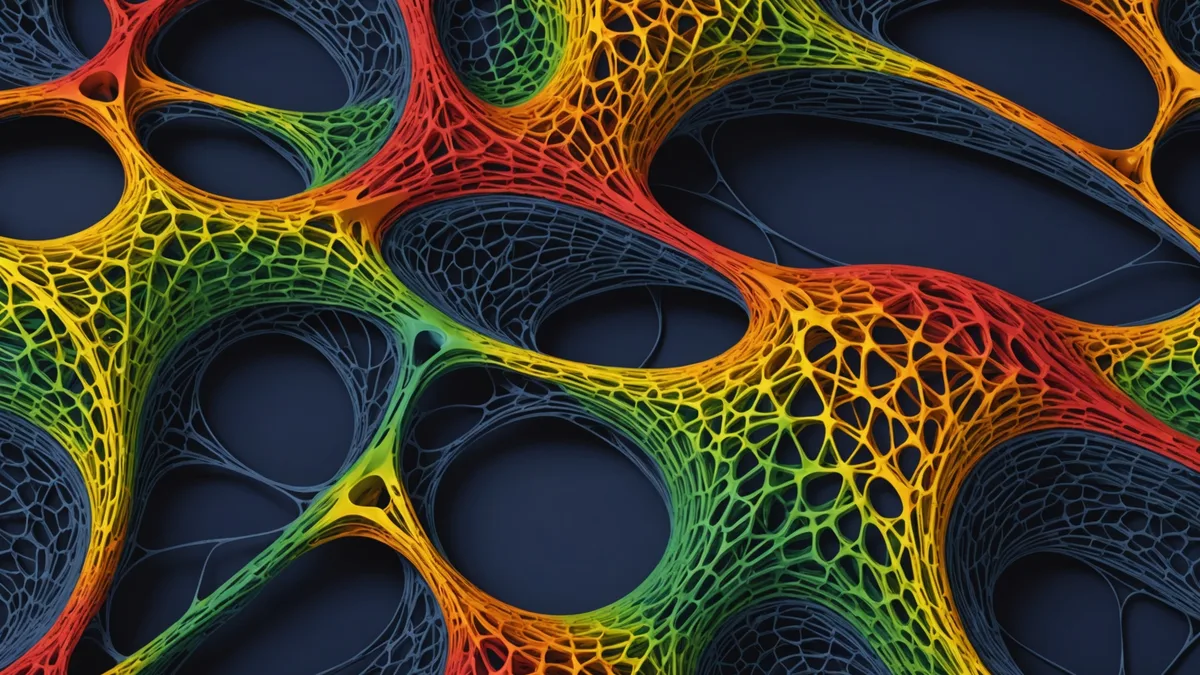
The way a load path forms inside a structure under stress is not random. Reading that pattern reveals which regions of material are essential and which are candidates for removal or redesign.
A proper trade study sweeps across two or three competing objectives simultaneously. The reason most engineering teams skip that step is not intellectual laziness. It is time.
Shape is the output of a physics-valid design process. Starting from material properties, load conditions, and boundary constraints is the only way to generate shapes that the laws of physics will actually permit.
Generating thousands of candidate geometries that each satisfy a set of physical constraints is not a search problem in the traditional sense. The constraint space is continuous, high-dimensional, and shaped by the laws of physics.